FAQ
FAQ
- I can't connect once I've logged in :( !
- Why some customers aren't into Skalin?
- Why are some emails not present in Skalin?
- Why are some MRR not present in Skalin?
- How often is data updated in Skalin?
- Skalin support suggests clearing my cache
- The "Last Contact" value shows 15 days even though I emailed my client yesterday
- Some information I added in Skalin has disappeared
- Why isn’t the Health Score syncing to HubSpot even though the synchronization toggle is checked?
- I see a button suggesting I install a new version of Skalin — who will be affected if I click it?
- I don’t understand the lifecycle phase (onboarding, run, etc.) of some of my clients
- I can only view a playbook, not edit it
- AI Assistant - What is the confidentiality level of data used by the AI?
- Sending bulk emails
- The notification center
- How can I automatically send exchanges from a tool with no connector to Skalin?
- Can I edit or delete customers, contacts or agreements in bulk?
# I can't connect once I've logged in 😦 !
If you get the message "Oops!, something went wrong" when trying to connect to Skalin :
You have logged in by clicking on a link / url that contains expired parameters and the validation process cannot certify your identity.
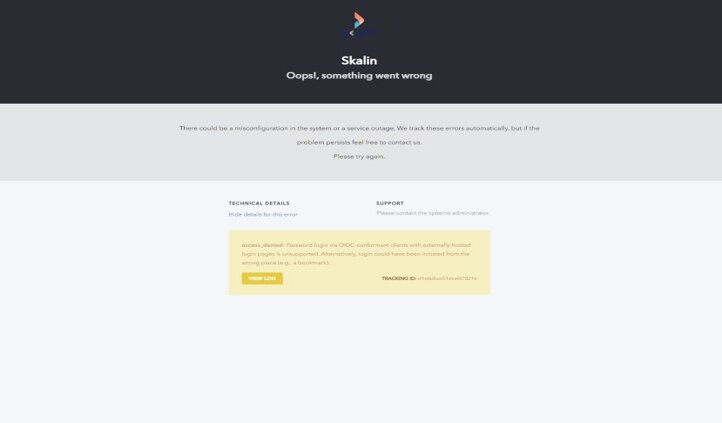
Reconnect by clicking on this link https://app.skalin.io (opens new window) and modify your bookmark if necessary.
# Why some customers aren't into Skalin?
There are two main reasons why your customer does not show up in Skalin:
- The customer in question does not meet the conditions that allow Skalin to synchronize it. For example, it doesn't have "customer" status if you use HubSpot, or it is no longer present in the Salesforce view that is synchronized with Skalin. The best way to do this is to check the requirements for your CRM, in the CRM Integrations section.
- The customer is present in Skalin, but has been churned: when you connect your CRM, there is an option "Make customers become churner if (...)" which automatically churns a customer who no longer meets the conditions of the initial synchronization. If this option is activated, a wrong operation in your CRM may cause a customer to become churn. In this case, select the customers whose Stage = Churn to check whether your customer is present, then assign him the appropriate Stage. To prevent this from happening again, check the configuration and deactivate the option.
# Why are some emails not present in Skalin?
There are several reasons why an e-mail may not be synchronized with Skalin:
- Your mailbox is not/no longer connected: even if you have connected your mailbox in the past, your mail provider may have expired your connection for security reasons. In this case, you'll receive an email and a reminder from Skalin inviting you to reconnect (see how to connect Gmail and Google Calendar and MS365).
- The e-mail is addressed to a contact who does not exist in Skalin. For an e-mail to be traced, the contact with whom you are exchanging must be registered in Skalin (see Data Model section). For reasons of confidentiality, Skalin will never create a contact, even if it has an email with the same domain name as a customer. If you add the contact a posteriori, Skalin will trace the history of exchanges up to a limit of 2 years.
- The contact exists in Skalin with a different email address from the one used to send the message. Same principle as above: Skalin needs to know the user's email address in order to link conversations. If the person has more than one email address, remember to add their secondary emails to their record, so that Skalin can integrate them too.
- The e-mail is not addressed to a Skalin user. Only Skalin users' mailboxes are synchronized.
- Your mailbox synchronization is not up to date. Skalin synchronizes your e-mail accounts and calendars every hour. It is therefore possible that one of your emails will not appear in Skalin for up to 1 hour.
# Why are some MRR not present in Skalin?
If no MRR comes up, you'll probably need to review the configuration of your integrations. In this case, please refer to CRM integrations and Billing tool integrations.
If some MRRs come up and others don't, there are several possibilities:
- Mandatory information is missing from the source tool, such as your CRM. For a contract to be valid, Skalin needs an amount, a start date, an end date or a duration. However, not all these fields are mandatory in a CRM. As a result, some contracts may not be complete, and may not be synchronized. Solution: complete the missing information in your source tool, and make it mandatory in future.
- The contract has expired: on the Customers home page, Skalin only displays the active MRR, i.e. the MRR linked to a current contract (start date < current date < end date). It is therefore possible that the contract is well synchronized but has expired, which is why no MRR is displayed. To be sure, go to the "Agreement" section of the customer file. Another tip: for expired contracts, Skalin displays the Renewal Date and End Date in orange, which can help you identify them more easily. Solution: remember to update the relevant contracts in the source tool.
- Skalin was unable to match the contract with an existing customer: when you use multiple data sources (e.g. CRM for customer lists and Stripe for contracts), Skalin must be able to identify that a customer is the same on your different systems. This can be done by means of a common identifier, an identical domain name or an identical account name. See our explanations on ID consistency. Solution: make sure you have at least the same account name on all your systems.
# How often is data updated in Skalin?
- Most of our native integrations are updated every hour. In other words, an item added to your CRM should be synchronized between 1 and 60 minutes later.
- Indexation in the main search bar: every 15 minutes
- Navigation events are ingested and updated every 30 minutes.
- Reports are updated daily
- Health scores are updated weekly, on Sunday night.
# Skalin support suggests clearing my cache
Here’s how to start fresh in Chrome:
- Open the web app in Chrome.
- Click the three dots ⋮ at the top right of the browser.
- Select More tools → Developer tools.
- In the Application tab, click Storage in the left-hand menu.
- Click the Clear site data button.
Then simply reload the page.
This will remove all local data and allow the app to restart with the latest version.
When should you use this procedure?
💣 Access or redirection issues
- The app doesn’t load or stays stuck on a white/loading screen.
- The user is redirected in a loop (e.g. login → dashboard → login).
- An internal link (or button) leads to a blank or incorrect page.
🔐 Authentication / session issues
- The user keeps being asked to log in even with valid credentials.
- The “Log out” button doesn’t work or seems to do nothing.
- The logged-in account doesn’t match the expected one (e.g. an old session still appears).
🔄 Display or outdated data issues
- Some data doesn’t refresh (e.g. dashboard or table showing old values).
- The app doesn’t reflect recent changes made on another device.
- The interface shows visual glitches after an update (misaligned buttons, missing modules).
⚙️ Issues after a product update
- Right after a new version deployment, some users encounter “weird” errors that others can’t reproduce.
- When a fix has been deployed, but a user still experiences the old behavior.
💡 In summary
When you experience “weird” behavior that support can’t reproduce, and it’s not related to your account or the server, it’s often useful to try a local reset (Clear site data) to make sure no cached data is interfering.
# The "Last Contact" value shows 15 days even though I emailed my client yesterday
"Last Contact" counts the time since the client responded (to an email, a call, or a ticket) or attended a meeting.
If you follow up with them by email, for example, this does not count as contact.
# Some information I added in Skalin has disappeared
If you had added an account owner or a tag at the client or contact level and this information was lost, you can check:
whether tags or account owners are included among the data synchronized with your CRM (in Integrations > Hub > HubSpot / Salesforce / Pipedrive > "Clients > Tag mapping or and CSM owner" or "Contacts > Tag mapping")
whether the integration with the client or contact data source is set to "Input only".
If both conditions are true, the data loss is explained by the fact that the CRM has empty values for tags or account owners — and since it controls the data flow, it sends empty values to Skalin during each synchronization.
The solution is to temporarily switch the integration to "Output only" while you add the tags or account owners, wait for a synchronization with the CRM to complete (so the values are sent from Skalin to the CRM), and then switch back to "Input only" or "Two-ways" mode.
If the data is coming into Skalin via the API, make sure that all existing tags are retrieved (GET) and sent back with each call, so that they are not deleted.
# Why isn’t the Health Score syncing to HubSpot even though the synchronization toggle is checked?

If the box to send the Health Score back to HubSpot is checked, and the synchronization indicates success, but the Health Score in HubSpot is still not updated, verify that the user used for synchronization is a SuperAdmin in HubSpot.
If not, you can change the user used for synchronization to a SuperAdmin user.
Keep the synchronization with HubSpot active, along with its configuration settings.
Connect the new user (with SuperAdmin rights in HubSpot) using the “Connect” button.

Set all synchronization fields for this new user to “Disabled”, then save.
Send us an email asking to copy your current configuration to this new user.
Once the switch is confirmed, delete the original user.
# I see a button suggesting I install a new version of Skalin — who will be affected if I click it?
If you see a banner indicating that a new version of Skalin is available, you can click the button to install the latest version and load the newest fixes and improvements for your current navigation session.
If you don’t click the button, the update will automatically install during your next visit or after an automatic refresh a few minutes later. The button simply lets you access the improvements sooner.
This installation only applies to you — it does not affect other members of your team.
# I don’t understand the lifecycle phase (onboarding, run, etc.) of some of my clients
Follow these steps to identify the source of a client’s lifecycle phase:
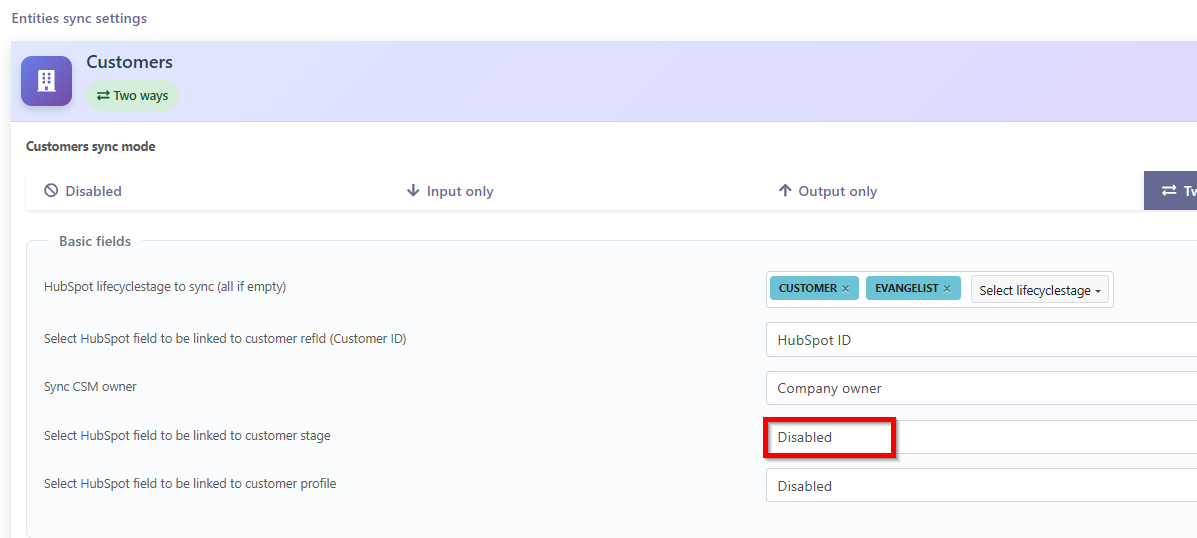
Check if the phases are synced with your CRM
Navigate to Integrations > Hub > Hubspot, Salesforce, or Pipedrive > Clients > Select HubSpot field to be linked to customer stage.
If a CRM field is selected, check whether the client’s phase comes from the CRM.
If this setting is Disabled, proceed to step 2.
Check the default phase in Skalin
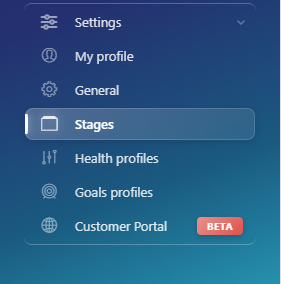
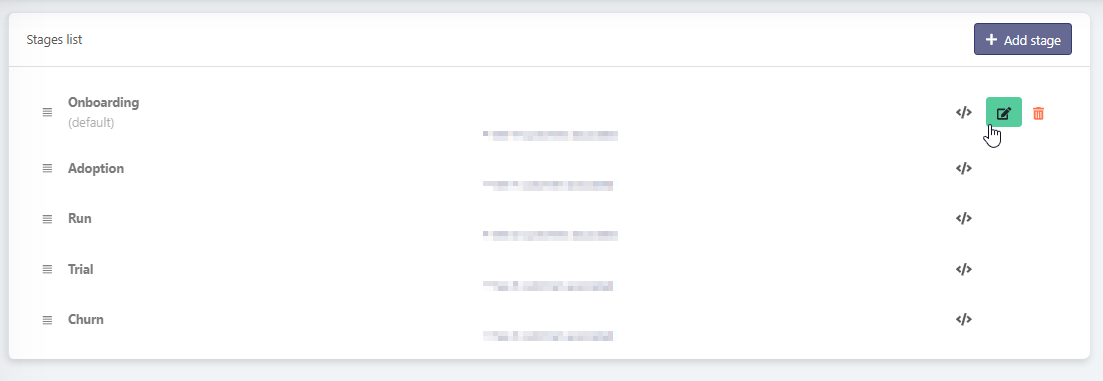
Go to Settings > Phases in Skalin and see which phase is used by default when an account is created and the CRM phase is unknown (see step 1).
If the default phase is incorrect, hover over the phase name to reveal the edit option and update it.
Check if a playbook changed the phase
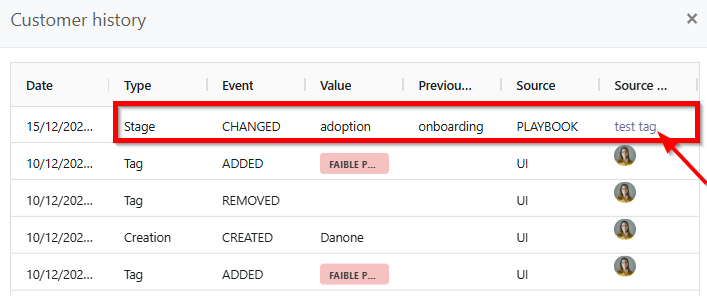
If the default phase doesn’t match what you see, a playbook may have updated the client’s phase.
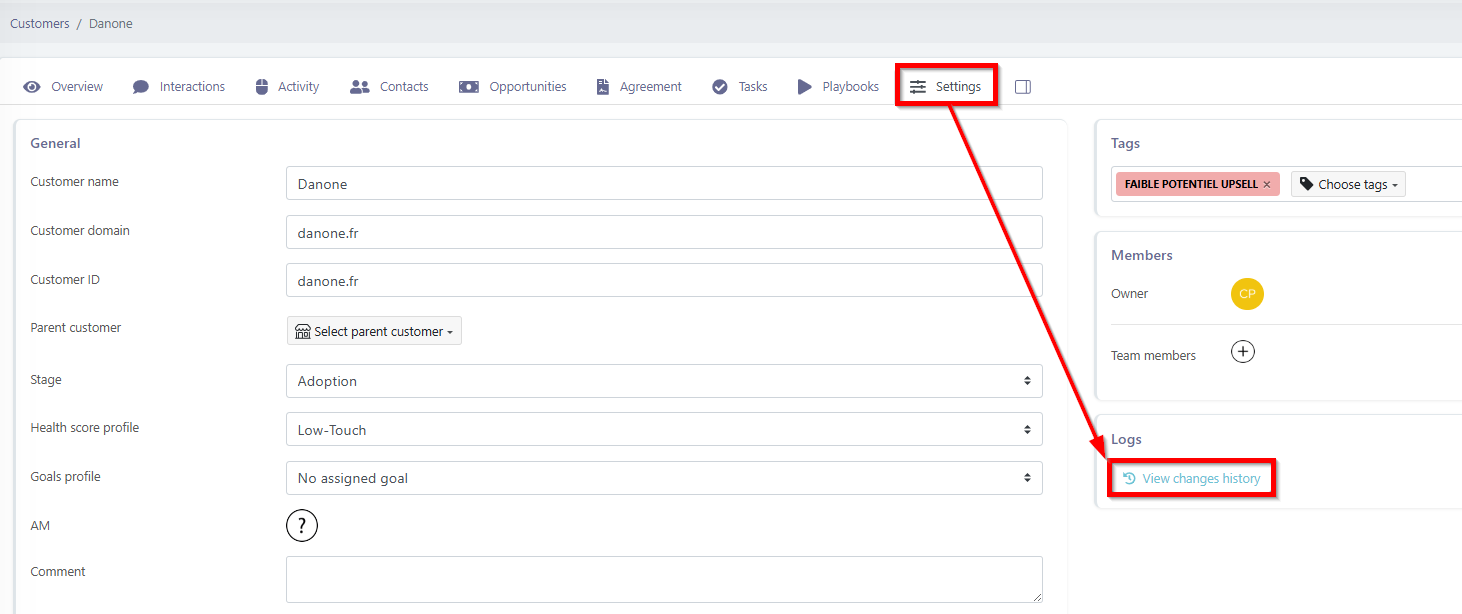
Open the client profile, go to the “Settings” tab, and click “Logs – View changes history”.
You can immediately see whether a playbook made the change and click directly on the responsible playbook to view more details.
# I can only view a playbook, not edit it
You probably have a CSM role rather than a Manager or Admin role, which does not allow you to edit playbooks. If you need to make changes, refer to a Manager or Admin to either grant you one of these roles or to propose the desired changes on your behalf.
# AI Assistant - What is the confidentiality level of data used by the AI?
When data is used as part of our AI Assistant features, several security and protection mechanisms are systematically applied:
1. Data Minimisation and Anonymisation
Before any data is sent to the AI, it is processed to strictly limit the information exposed:
- Sensitive elements such as email addresses and phone numbers are anonymised
- Passwords and critical data are never transmitted
- Only the information strictly necessary to generate results is used
2. No Model Training on Your Data
Data processed by the AI is not used to train models. It remains strictly isolated to your use, with no subsequent reuse.
3. Localised and Secure Data Processing
AI models are hosted and operated within the same data centre environment as our platform, located in Europe. This means:
- No data transfer to external or out-of-controlled-zone infrastructures
- Data remains permanently within a secure, controlled environment in Europe
- Reduced exposure risks as well as lower latency
4. Secure Data Exchanges
All data exchanges are:
- Encrypted (secure protocols such as TLS)
- Governed by market-standard security practices
5. European Compliance and Data Governance
Our architecture is designed to meet European regulatory requirements (in particular the GDPR), with strict control over data processing and data flows.
6. Privacy by Design Approach
Security and confidentiality are built into the product from the ground up:
- Access control based on the principle of least privilege
- Full processing traceability
- Environment segregation
# Sending bulk emails
# Is there a limit, and what are the advantages/disadvantages compared to using a newsletter platform?
Skalin is directly connected to user accounts via the Gmail API. In practice, emails are sent from the user's actual mailbox, not through a third-party sending infrastructure (such as a newsletter platform or transactional email service).
This comes with several significant advantages:
- emails are perceived as "human" and authentic (rather than mass sends)
- they benefit from the user's own Gmail account reputation (and therefore have better deliverability than newsletter-type or service emails)
- they integrate naturally into existing exchanges (threads, replies, etc.)
- the sender's name is displayed clearly, and the usual email signature appears at the bottom of the message
Google Workspace allows up to 2,000 emails sent per day per user account (opens new window), although it is recommended not to exceed 500 messages per day per user.
This provides quite a bit of flexibility for volume sending, especially since the load can be distributed across the mailboxes of different CSMs.
Regarding spam risk, Google pays much more attention to engagement signals than to volume per se (you can end up in spam with low volume, and vice versa). The real risk arises if you send messages that are perceived as irrelevant and your users start marking you as spam (but this risk is the same for newsletter or service email sends).
Newsletter/service email sends do allow for massive volumes, but they also come with drawbacks. By default, with a newsletter-type send, the IP used is shared with other clients, meaning the send starts with a "neutral" reputation at best — which is lower than that of standard mailboxes (even if this is never explicitly stated).
In summary: you can send at high volumes with Skalin (though not massive ones), with better deliverability, while maintaining a "natural conversation" mode with your customers. With service emails you can go massive, but you lose the natural feel and start with inherently lower deliverability.
A few options to pace email sends and avoid hitting the limit:
- Choose a trigger that smooths sends over time — for example, "No contact usage since 1 day" (+ capping to trigger the playbook only once per contact) targets users one day after their last login. Even for users who log in every business day, they likely won't connect on weekends and will receive the email then. ➡️ Does not work for re-engagement playbooks targeting contacts who never log in.
- Depending on the volume of customers per CSM, you can choose to send emails with manual validation, allowing each CSM to approve emails one by one and personalize them based on the customer context and any other related topics.
# The notification center
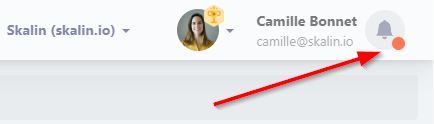
In Skalin, you can be notified of important information directly in the notification center, located at the top right. When a red dot is blinking on it, it means you have a new notification to review.
Notifications come from:
- the Skalin team, to inform you of important new features,
- or your colleagues, who have mentioned you on an interaction, an opportunity, or a task for a given customer (using @firstname).
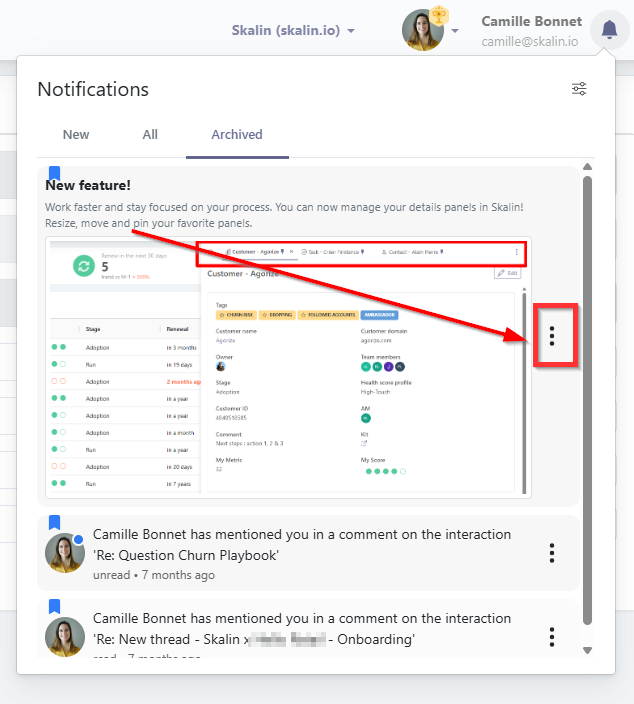
When you receive a notification, the notification panel opens and you see the new notification in the "New" tab. You can then:
- click outside the panel: the notification is then considered unread and will reappear the next time you log in to Skalin,
- click on the notification: it will be marked as read and will move to the "All" tab,
- click the three dots next to the notification, then "Archive" to move it to the "Archived" category. This category is where you store important notifications that you want to distinguish from all other received notifications.
# How can I automatically send exchanges from a tool with no connector to Skalin?
If you're using a tool that doesn't have a native connector with Skalin, you can still forward your exchanges using a dedicated forward email address.
Each account in Skalin has a Skalin ID that you can find in Settings > General > Account information. The forward address uses the following format: [Skalin ID]@forward.skalin.io
Simply set up an automation in your source tool to send a copy of every exchange to this address. Skalin will receive these interactions and automatically associate them with the relevant customer record.
Tips
This forward address is the same one used for the Freshdesk connection.
# Can I edit or delete customers, contacts or agreements in bulk?
Before deleting items in bulk, start by understanding why these accounts (or duplicates) were created. Data synchronizations with Skalin are continuous: if the customers you delete are still present in your connected data sources, they will be automatically recreated through the integration. So first check your synchronization sources to prevent the items from reappearing once the cleanup is done.
Once the root cause has been addressed, you can edit or delete in bulk via a CSV file import:
- Create a CSV file of your data (from an export, for example) with a column named deleted.
- Enter the value 1 for the items you want to delete and 0 for those you want to keep.
- When importing, make sure the deleted column is properly mapped.
This performs a "bulk" deletion and saves you a considerable amount of time. It works the same way for your customers, contacts and agreements.