Customers list
All customers list
# Accounts list mode overview
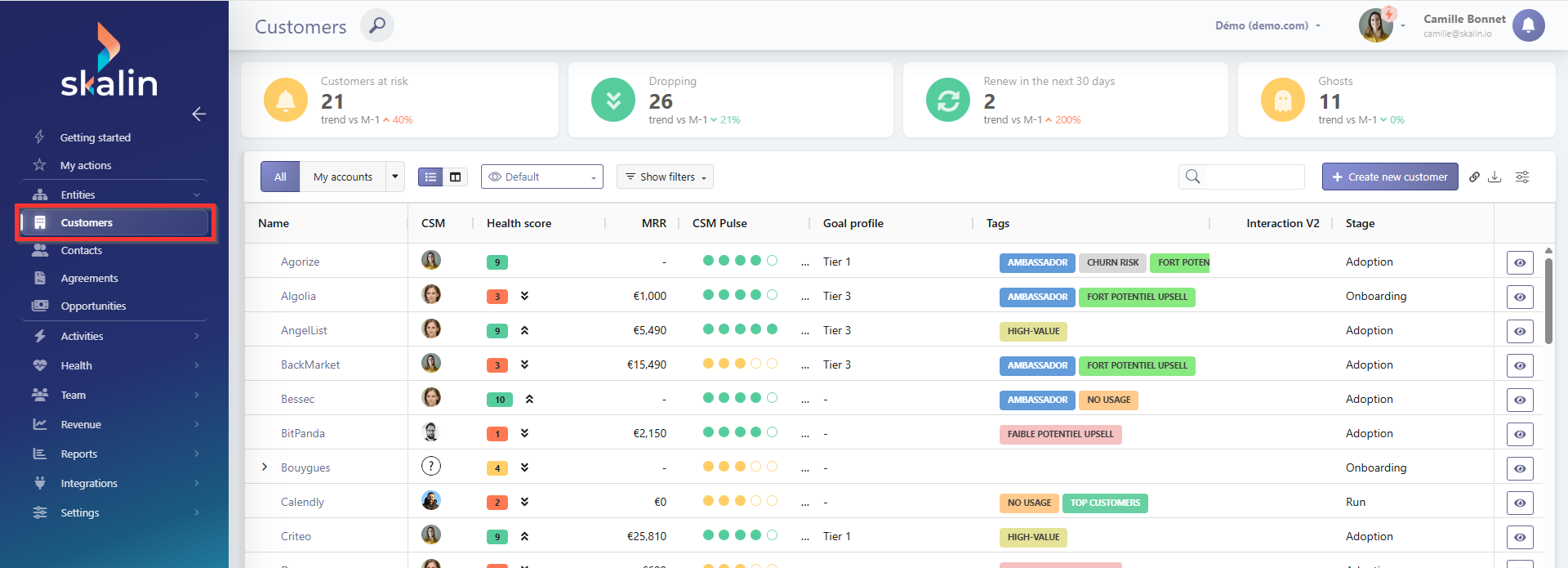
By default, the home page corresponds to the Entities > Customers entry in the left-hand menu. Here you'll find the most important information about your customers, presented in the form of a list.
Tips
By default, customers in the churn stage are not displayed in this view. To include them, use the filters.
# KPIs at the top
The color of the icon representing each KPI depends on the trend compared to the previous month: green if the trend is positive, yellow if it is average, and red if it is negative.
These indicators are not affected by any applied filters. Customers in the churn stage are not included in these KPIs.
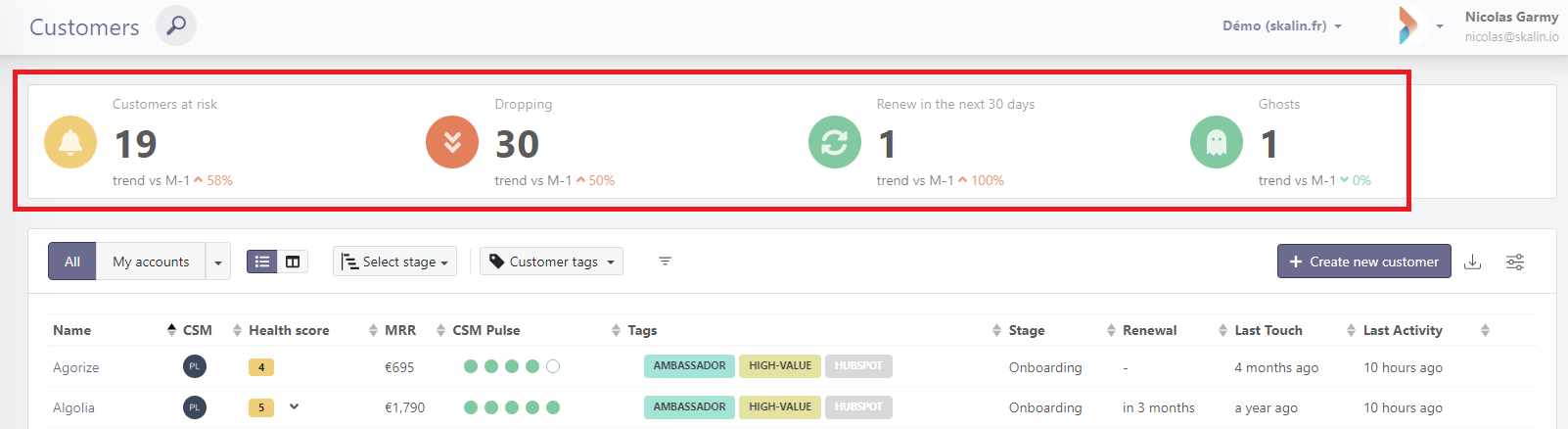
- Customers at risk: corresponds to customers with a health score of 3 or less, i.e. all those corresponding to the health score with the red color code. (excluding churners)
- Dropping: corresponds to customers whose health score has dropped compared with the previous week.
- Renew in the next 30 days: corresponds to customers whose notice date is less than 30 days away. For contracts with tacit renewal, the notice date is equal to the contract end date minus the notice period; for contracts without tacit renewal, the notice date is equal to the contract end date.
- Ghosts: corresponds to customers with whom you no longer interact and who have not used your product for some time. By default, this parameter is set to 30 days without incoming interactions and 30 days in connection. These settings can be changed in Settings > General (opens new window).
# Customised customer overview
By clicking on the button  in the top right-hand corner, you can customize the columns to be shown/hidden, as well as the number of items to be displayed on the page. This configuration is specific to each user/device and therefore has no impact on the display of other members of your organization.
Note that all those KPIs are pre-calculated by Skalin and require no special configuration (for custom fields, see below).
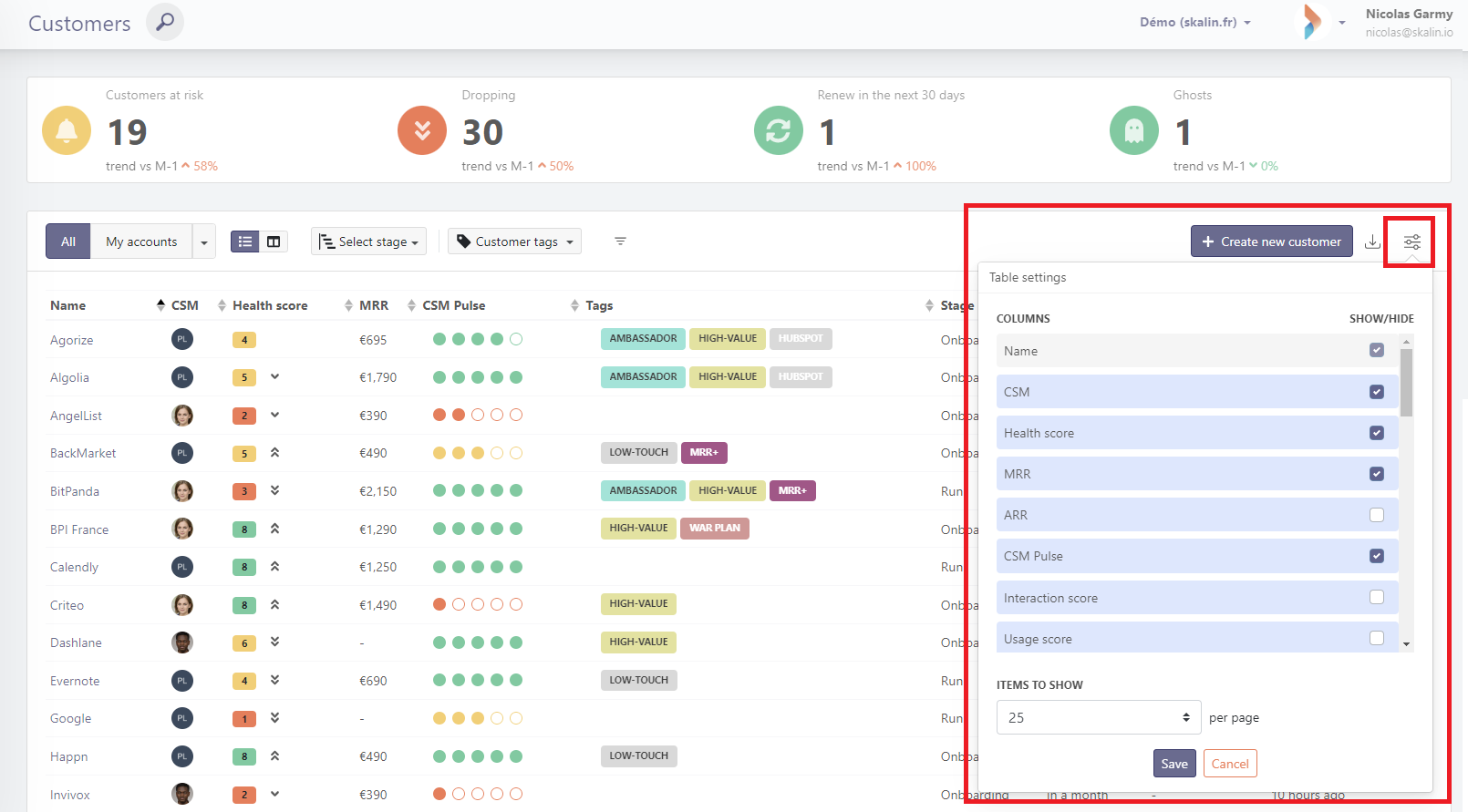
Definition of available fields (default fields*) :
- Name*: customer name
- CSM*: account owner
- Health score*: customer's health score, on a scale from 1 to 10
- MRR*: customer's MRR
- ARR: customer's ARR
- CSM Pulse*: CSM sentiment regarding account health, on a scale of 1 to 5
- Interaction score: score based on interactions, on a scale of 1 to 5
- Usage score: score based on product usage, on a scale of 1 to 5
- Agreement score: score based on contractual information, on a scale of 1 to 5
- System tags: set of system tags assigned to the customer
- Tags*: all tags assigned to the customer, excluding system tags.
- Stage*: phase of the lifecycle (default: trial, onboarding, run, churn. Customizable, see settings section (link).
- Heathscore Profile: health score typology (1 typology by default, customizable).
- Goal Profile: category of follow-up goals assigned to the customer.
- Plan: commercial offer available to the customer
- Contacts: number of contacts in the account
- Playbooks: number of Playbooks active on this customer
- Start date : start date of the latest contract (we have an open feature request to get the start date of the first active contract instead)
- Renewal*: notice or contract end date. For a contract with tacit renewal, the notice date is equal to the contract end date minus the notice period; for a contract without tacit renewal, the notice date is equal to the contract end date.
- End date: contract end date
- Auto renew: contract with or without tacit renewal
- Last Touch*: date of the last contact received from the customer. It reflects the last exchange received from them, regardless of any unsuccessful outreach attempts made since. The "last touch" corresponds to an interaction involving the customer (incoming email, reply to an email, meeting, call). An unanswered email sent by your company is not counted here.
- Last Activity*: date of last connection to your product.
- Last meeting: date of last meeting with a customer.
- Last sponsor touch: date of the last contact received from or successfully held with the decision-maker, i.e. the last exchange they took part in (incoming email, reply to an email, meeting, call). An unanswered email sent by your company is not counted here.
- Touch last 30d: number of contacts with the customer over the last 30 days
- Product stickiness : WAU/MAU → Weekly Active Users / Monthly Active users. It shows how well a product keeps users engaged and coming back over time. A “sticky” product is one that customers find valuable enough to use frequently and consistently, making it an integral part of their routine or workflow.
- Usage last week: number of sessions over the last 7 days
- Usage last 30d: number of sessions over the last 30 days
- DAU (daily active users): number of users active the previous day
- WAU (weekly active users): number of active users over the last 7 days
- MAU (montly active users): number of active users over the last 30 days
- Avg interaction 90d score: average sentiment score over the last 90 days. The evolution is calculated between the 0-90 day period and the 90-180 day period, expressed in points. The score is calculated when you had at least one interaction in the last 0-90 days; the evolution is calculated when you had interactions during both periods.
- Avg interaction 12m score: average sentiment score over the last year. The evolution is calculated between the current year and the previous year, expressed in points.
- Created at: client creation date
- Updated at: last update date of customer record
# Add custom field
To create your own custom fields, go to the Custom fields section of this document. Once you've created your fields, you'll be able to show/hide them just like any other field.
# Row display options
The column selector also includes display options. If you use parent/child accounts, the Expanded by default option automatically expands the chevrons of all parent accounts, giving you visibility into the lowest-level child accounts without having to manually expand each parent.
# Kanban view of customers (by stage)
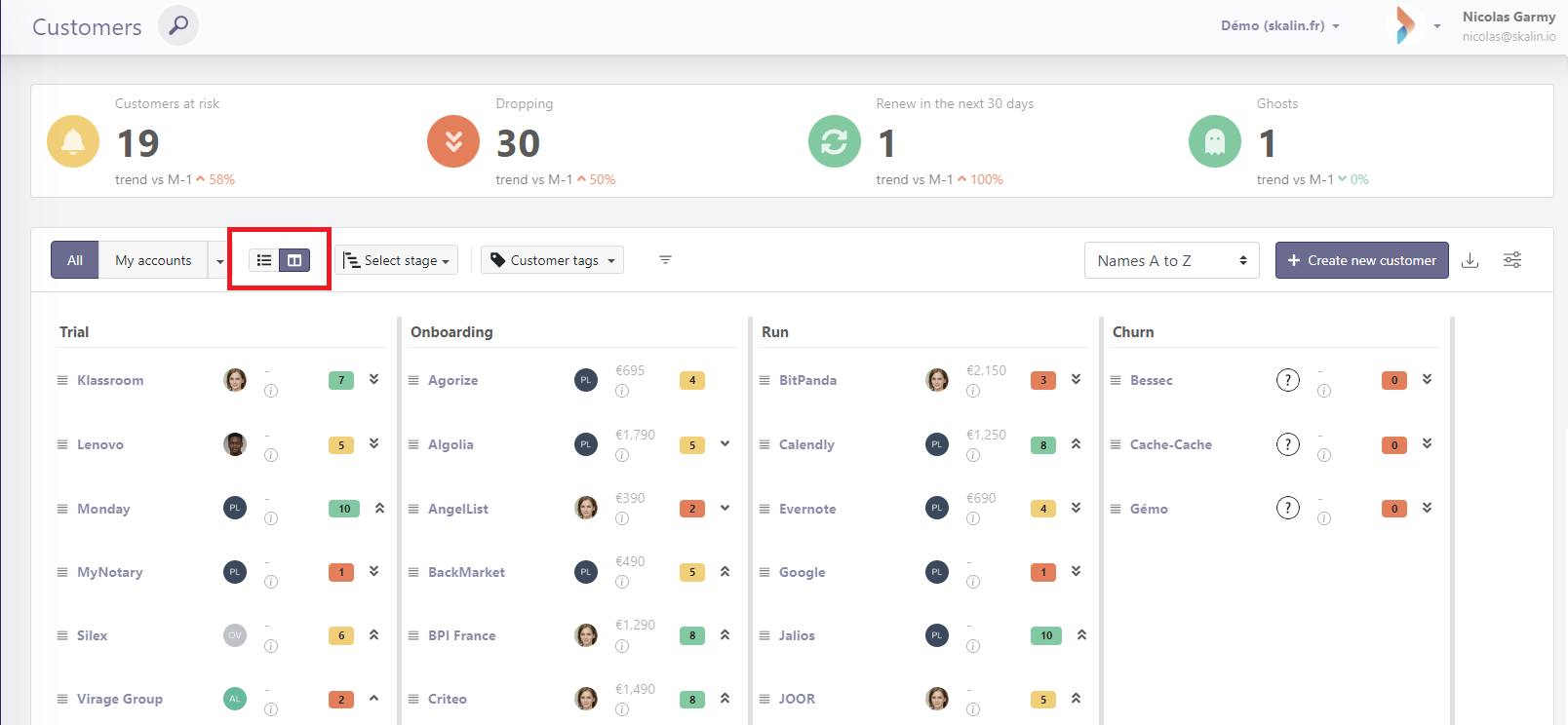
For the more adept, a Kanban mode is also available: this allows customers to be displayed according to their "stage" (life cycle). Customers can be moved from one stage to another by simply dragging and dropping.
Here's how to customize and organize your customer stages.
# View Filtering and Tags
Advanced filters and tags work together to let you segment your customer portfolio dynamically. Rather than maintaining static lists in a spreadsheet, you build multi-criteria views that update automatically and stay active as you navigate Skalin.
For full documentation (basic and advanced filters, saved views, system and custom tags), see Key Concepts: Filters, Tags and Custom Fields.
Parent accounts and filters
When filtering on a specific stage or criterion (e.g. churn customers), it is normal to see rows for customers that do not directly match the filter. These rows represent parent accounts with one or more child accounts that match the applied filter. Parent accounts are always displayed as long as at least one of their children appears in the results.
# Text search
You can also search for a customer by entering its name in the search bar at the top right of the "Customers" page. The results displayed adapt in real time to the first characters entered.

Reminder
By default, the Customers view does not display churned customers. So, if you cannot find the customer you are looking for using this search, it may be because they are in the churn phase. In that case, you need to enable the display of churned customers before applying this filter.
If you use the search bar at the very top of Skalin, you will be able to find your customer even if they are in churn.
# Bulk actions (multi-selection)
The first column of the table contains a checkbox in the header row.
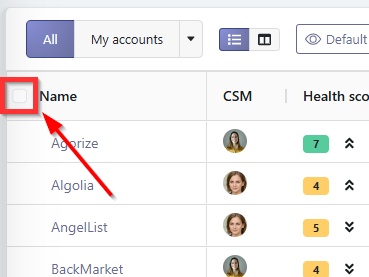
Checking it displays a checkbox next to each customer, allowing you to select individual accounts or select all at once.
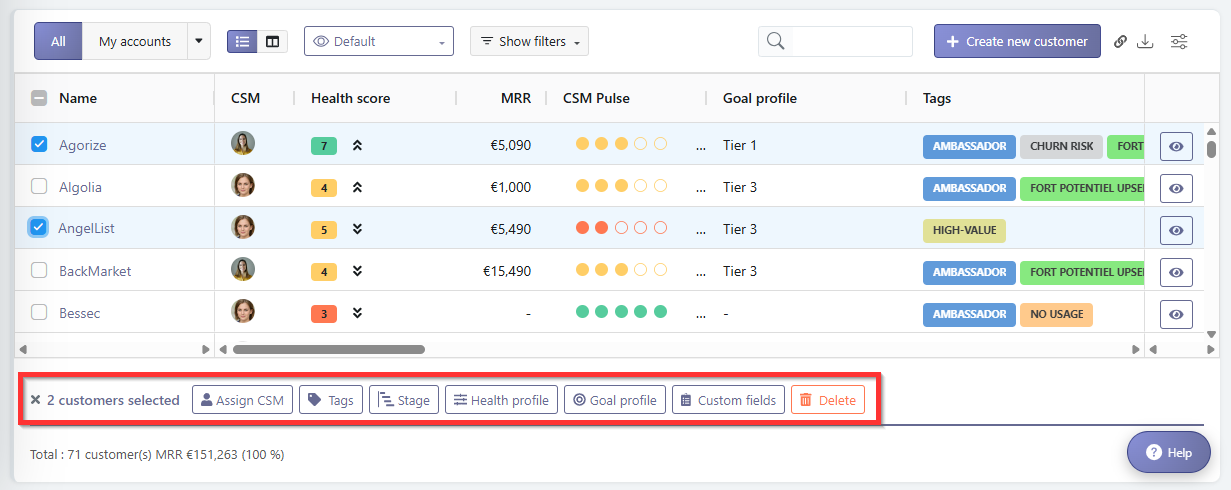
An action bar then appears at the bottom of the screen with the following actions:
- Assign a CSM: reassign one or more customers to a given CSM
- Add / remove a tag: apply or remove a tag from the selection
- Change stage: move the selected customers to a given lifecycle stage
- Change health profile: assign a health score profile to the selection
- Change objective profile: assign an objective profile to the selection
- Edit a custom field: update a custom field value across all selected customers
- Delete: delete the selected customers
Tip
This feature is particularly useful for mass reassignment or requalification operations, without having to open each customer record individually.
Editing or deleting in bulk beyond these actions
To edit or delete customers in bulk beyond the actions above (for example via a CSV file import), see the FAQ: Can I edit or delete customers, contacts or agreements in bulk?
# Extract customer file
You can download all customers by clicking on the button  at the top right of the page. The extract will be available in .csv format and will contain all available columns.
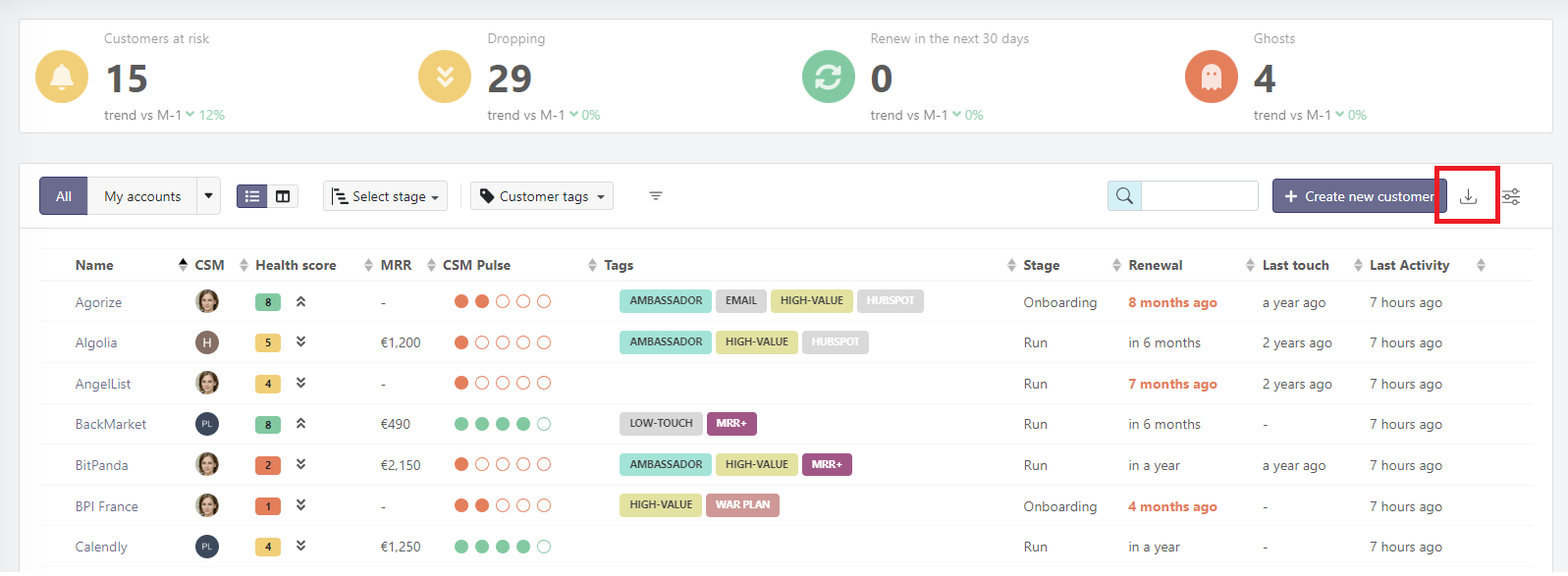
Tip
The export contains the list of customers displayed on the screen. Feel free to use the filters on the screen area to download only relevant cust